Showing posts with label Boston. Show all posts

Sunday, June 9, 2019

Canceled for "Flooding:" The Cellcom Green Bay (Half) Marathon


In my marathon career, I have registered for 49 marathons, finished 46, have 0 DNF (did not finish), and 3 were canceled. The 2012 New York City Marathon was canceled due to Hurricane Sandy. It was the correct call, but they waited to decide and announce it the Friday before the race when people had already arrived. I was in the car with my now-wife driving up the BW Parkway when we heard the news. My second canceled marathon was the 2017 Mississippi Blues Marathon. I caught an early morning flight to Chicago to transfer. There was a freak ice storm and the pilot told us (we hadn't boarded) that he couldn't land. When the flight was canceled, I caught a flight back to DC. Later that night, I heard the marathon was eventually canceled due to ice on the course. They made the right call.

Packet Pick Up at Lambeau Field

In each of these instances, I was fortunate to be able to pick up a replacement race. The week after New York City, I ran the Marshall University Marathon in Huntington, WV. They offered registered New York City Marathon runners a discount. The day that Mississippi Blues was supposed to be, I ran the Al Lewis 10 Miler in Maryland, hosted by my running club, DC Road Runners - a free race since I am a member. I try to understand how difficult it is to put on a race and the deliberations that must go into deciding whether to cancel a race. For New York City and Mississippi Blues, they were both obviously correct calls.
Ready for the Kids' Run

For the Green Bay Marathon, I was really disappointed with the decision to cancel the full, and I believe it was the wrong call. When I woke up to begin race preparation, I read this text:

The Cellcom Green Bay Marathon together with our public safety and medical partner has made the decision to cancel its marathon Sunday, May 19 due to flooding on the course.

Ready to race around the football field

I reread the text several times before getting to the second part:

Marathoners will have the option to run the half. Further details here.

I was bloated from my carb load. I tried to get ready and leave my room so my son and wife could sleep. I was so mad. I read Facebook comments and even texted to ask if we could run the half twice.
A selfie during the race inside Lambeau Field

I went down to the hotel lobby, but it was so early (5AM) that no one was there. I decided to head back to my room, where Miles was awake. I put on the iPad and climbed back into bed. Around 6AM, I got up and Laura wondered why I was back in bed. I told her and she was so sad for me. She was really supportive as I was devastated. I was ready for a marathon, not a half. I eventually left the room to begin a warm up run to the start.


Packet Pick Up with the Family

The "flooding" was near my hotel, so I got a good look at it. That only made me upset since there wasn't that much water, runners could have been diverted or just run through it. No one was going to get swept into the River. And, the water on the course was in the 25th mile, which was near the end of the race. There was maybe 50 meters of water on the trail by the river. In my opinion, runners could have been directed around the water.


Frozen custard near Green Bay at Zesty's

I ran down to the start and got ready. A photographer wanted to take my picture, and I declined. I didn't want to remember this race. I thought since it was "just a half" I should try to PR. That's not how it went. My mind was ready for the full, and my body didn't respond. The first few miles were okay, but then I lost my pace and just held on. The half was run through neighborhoods and a part went around Lambeau Field. Running through the stadium was neat, but the rest of the course wasn't particularly scenic or memorable. It wasn't a memorable race or a particularly fast time. I barely broke 1:27. A stranger raced me to the finish, and I am thankful he did otherwise I wouldn't have cracked 1:27. Here is the proof that I finished.


Frozen custard near Milwaukee inside Kopps


I went to the results desk to check and see if I placed in my age group. 7th. I did not. I ran back to the room to get my cool down. When I got back to my hotel, the flooding had receded and wouldn't have impacted the race. I was looking forward to racing Green Bay to add it as another state on my 50 state marathon quest. I know that it is a tough decision to cancel any race, but in my opinion, the organizers made the wrong call. As a final kick-in-the-pants, when I finished the half, the announcer mispronounced my name which summed up my race experience.


Tasty!

Results:
71 overall out of 2640; 65th male; 7th age group
31:37 at 5 mile mark; 1:05:42 at 10 mile; and 1:19:19 at 12 mile
6:38 average pace

Email after the race: "Dear Kenny Ames, Thanks for competing in the Cellcom Green Bay Marathon, you finished in a time of 1:26:41. Your detailed results are available here: Detailed Results and you can search all competitors and categories here Results."

In Milwaukee near Lake Michigan

It was a mistake to cancel the full marathon. I saw the "flooding." It could have easily been run through or run around. I am very upset that the full was canceled after traveling from DC with my wife and young son. Plus, as a member of the 50 state marathon club, I will have to come back to Wisconsin at a later date to check off Wisconsin. Do not worry - I will find another city to run as I do not plan to come back to Green Bay.


Wednesday, February 20, 2019

Taper Not Required: DC Road Runners Club George Washington Birthday Marathon


Usually before a marathon, I plan my pace, my taper, and my carb load. This race was different as I didn't expend much energy in preparation. I didn't have a proper taper - seven days out, I completed my third consecutive 100 mile week. The week leading up to the race, I took off Sunday and Monday, ran my usual pre race tempo (5 repeats of 4 minutes at 6:20 pace with a 1 minute standing rest), and planned to run a few more miles Wednesday, Thursday, and Friday. But, with reports of snow between 1-3 inches on Saturday and cold temperatures Sunday, I thought the race would be canceled since it has been in the past. I was in Pittsburgh for work, so I ran 10 miles on Wednesday and 15 on Thursday thinking why taper if there won't be a race. Then the forecast changed and I received an email from the race director saying the race was on. Well, shoot! I didn't run at all on Friday or Saturday. I went into the race with low expectation. I chatted with my coach on Friday and we thought a 6:50-7:00 pace was the goal. I was going to treat the race as a long marathon pace tempo.

The start line

Friday night, my wife and I watched Bohemian Rhapsody and I bought the album, meaning I had Queen stuck in my head the whole race (We Will Rock You, Radio Ga-Ga, and Killer Queen cycled through my head during the race). Before the race, I tried to assess if there were any 40+ runners that would challenge me for first master. I thought there was a good chance I could claim that prize. We have access to the Greenbelt Youth Center for check in and to wait. The race starts a short walk away in the neighborhood and runs out to the Beltsville Agricultural Research Center, three loops, and then back to finish not far from the start. They introduced the two elite athletes and off we went.

Early in the race

Turning a corner
The first mile of a marathon can be tricky. I don't want to get sucked out and run too fast: too many runners usually do that and this race was no exception. If I go out too slowly, I fear that I won't be able to get to my pace. I have to remind myself that I cannot "win" the marathon in the first few miles. I was pleased that my pace was fine. The second mile was only fast because it was mostly down hill. In the third mile, a fellow club member started to run with me. He's a 2:40 marathoner and was going out slow as he had a 100 mile week recently as well. We ran together for most of the first loop. I told him I was going to try to keep it to a 7:00 and didn't want to hold him back. We chatted casually about running, race strategy, and other topics. As we went by the on ramp to the BW Parkway, he picked up the pace and I wished him a good race.

The short out and back section before the loop

Headed to the loop

I have run this course before as I competed in the relay portion. I know where the rolling hills are. That familiarity was helpful to me in pacing and strategy. Despite not having tapered, my legs felt okay and I had settled into a slightly sub 7:00 pace. I hit the end of the first loop in about 1:07, which was on target for a sub 3:05.

First lap complete

Finishing first lap

The first few miles of the second loop have climbs, so I took it easy. I hit the half in 1:31:02 - happy with my effort and figured an even split would give me a 3:02-3. After the half, there was a chance to pick up the pace with some down hills, so I did since I felt good. At the 16 mile mark, I passed a guy I thought was a master runner. He was in his late 30s and starting to fade - he went out too fast.

Feeling good!

Thumbs up!
At this point of the race, I was lapping some runners. They served as rabbits in my mind, something to go and catch and pass. It kept me motivated and my pace steady. In my head, I had Freddy Mercury's Live Aid performance from 1985. I was able to pick up the pace slightly, dropping my average mile down to 6:55. At about the 20 mile mark which is on the third loop, I caught my friend from earlier. I encouraged him to come with me, but he was done and jogged it the rest of the way.

Having a good time!

I don't remember much about the last loop other than feeling pretty good. I started to do math to figure out my time. I thought I was in 2:59 to 3:02 range. Breaking 3 was going to be tough because of the long hill in the 26th mile. But 3:00 and 3:01 were in the cards. One by one, I was able to pick off runners ahead of me. Leaving the last lap, I saw a guy I hadn't seen and asked volunteers if he was relay. They didn't know. I caught him - he was a solo marathoner. As the climb up the final hill began, I tried to make sure I put space between us so that he wouldn't catch me. I also wanted to leave something for the final kick. Then, I heard two runners approaching, so I tried to pick up the pace. At the top of the hill, I began my kick with the goal of not getting passed. With less than .2 left, I caught one more runner and crossed the finish line, good enough to earn a top ten finish.

My finishing kick!

With a 3:01:15, it was my 5th fastest marathon (2:59:31 Houston 2016, 2:59:32 Rock N Roll DC 2018, 3:00:58 Bismarck, ND 2015, 3:01:06 NYC 2018), second consecutive 3:01, and my 45th total marathon in 27 different states. 15 of my 45 total marathons are sub 3:10 and Boston Qualifiers according to my age and qualifying standards when I raced them. While I had already run Baltimore, Maryland, in 2007 (3:49), this one gives me Maryland in under 3:30 and puts me on track for 50 states sub 3:30 (I have to redo California). It was also my first marathon in February. Once I race in August, I will have run a marathon in every month.

Finishing in 3:01:15

I was really pleased with my race. My only disappointment was two men over 40 that finished ahead of me. I wasn't going to run a 2:46, but the runner who placed ahead of me put down a 2:59:06. My effort was good for 10th out of 181, 3rd over 40, and technically 2nd age 40-49. And I did this on a course that was rolling hills with a few tough climbs.

My miles: 6:55 / 6:49 / 6:59 / 6:59 / 6:58 / 6:59 / 6:51 / 6:56 / 6:49 / 6:53 / 6:53 / 6:58 / 6:58 / 6:40 / 6:37 / 6:52 / 6:48 / 6:47 / 6:57 / 6:48 / 7:02 / 6:51 / 6:55 / 6:55 / 6:59 / 7:25 / 5:37 (final .3)

Splits:
Mile mark = Overall time (Overall pace)
2.2 = 15:11 (6:54)
5.8 = 40:35 (7:00)
9.7 = 1:07:27 (6:58) finished first loop
Half = 1:31:02 (6:57)
17 = 1:57:16 (6:54) finished second loop
20.4 = 2:20:51 (6:55)
24.3 = 2:47:49 (6:55) finished third loop
Finish = 3:01:15 (6:55)
Second half = 1:30:13
47 second negative split

Results: https://results.chronotrack.com/event/results/event/event-47603

A sampling of the comments I received:

"Nice job, Kenny. Glad one of us continued to move forward after the half way point."
"You were strong! No taper and top 10 with negative splits! Congrats!!"
"This course was harder than NYC and you nailed it!"
"Excellent time on a real bear of a course!"
"Nice job Storm!"
"Great job Kenny - proud of this effort!"
"You looked like having fun the whole time! Too bad it takes 100+ mile weeks to look that relaxed and fast at the same time!"

Thanks to DC Road Runners for hosting a fun and well-organized race and to my supporters and fellow runners! Next up: Boston!!

P.S. For Boston, my brother is fundraising for Dreamfar High School Marathon, the charity that provided his bib. If you are able to support Team Ames, it would be greatly appreciated!

Sunday, April 29, 2018

I am the Storm! 2018 Boston Marathon Recap


“Fate whispers to the warrior, `You cannot withstand the storm,’ and the warrior whispers back, `I am the storm.’” -Unknown

April 16, 2018 weather: cold, wet, and windy. The course was rain swept and a strong, 30 mph headwind pushed against the runners. The weather was going to be so bad, for the first time in a long time the traditional 11AM Red Sox game was postponed. It was the toughest conditions I ever faced... except for the almost 90 degree day in Boston for my first Boston Marathon in 2012.

Like last year, I flew to Boston Saturday afternoon/night with my son since my wife works on Monday (Patriots Day is only a holiday in Massachusetts and Maine). Having my family live in Massachusetts made this plan work. Miles was great waiting for our flight and on the plane. We shared an ice cream and read and watched Elmo. I still wasn't feeling great - I had food poisoning Wednesday night, felt really ill Thursday, and was still in some pain Friday so I canceled my five mile run. Saturday was the first day my stomach wasn't in pain. I was worried I wouldn't get a good carbo load.

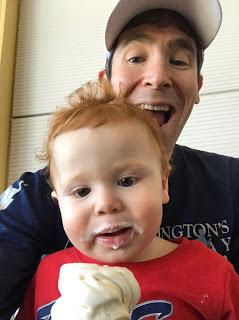
A preflight ice cream cone waiting to board


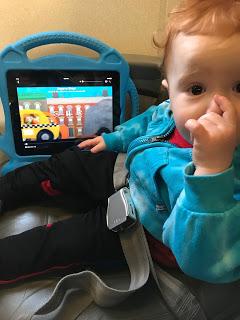
Miles watching Sesame Street during takeoff


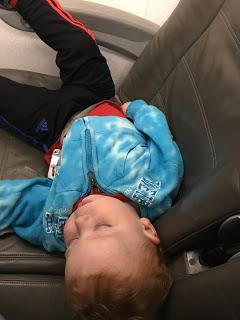
Miles slept on the plane to Boston
My parents met us in Logan and we drove to their home in Foxborough. He went right to bed and I followed shortly later. Sunday morning, I drove my father's car into Boston. Usually the packet pick-up is at the Hynes, but this year it was at the Seaport Convention Center. We had to wait in line outside for the doors to open, and I was spotted by Alex and his wife, a fellow runner from the DC area who met me years ago in Hopkinton waiting for the race to start. He was coming off an injury, but I saw that he ran quite well.

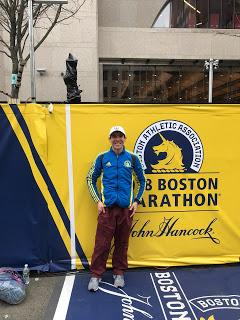
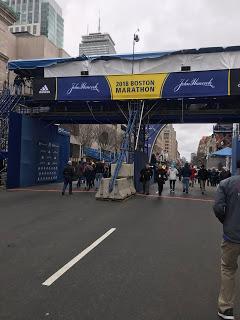
Standing on the finish line

A view of the finish line
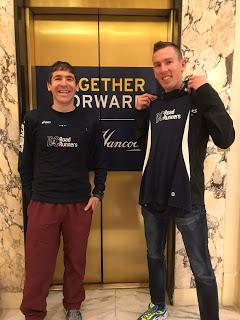
I didn't linger at the expo since it was $14 for the first hour to park and didn't want to pay for a second hour. I met with my coach, Ryan Vail, for coffee at his hotel near the finish. Amazingly, I found street parking (free on Sunday) walking distance from where we met. It was my first time meeting him in person. On the way to see him, I took a few pictures at the finish line, something I had not done in the past. He hoped to have a good race and we talked strategy and family. I presented him with my club's singlet.


A picture with my coach, Ryan Vail


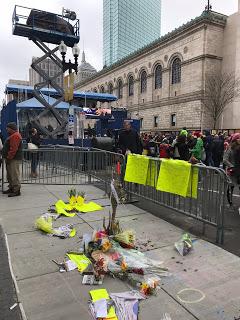
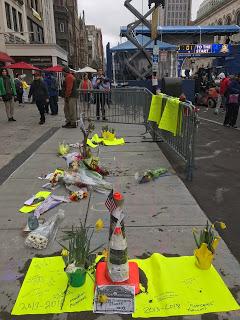
Memorial to the 2013 Boston Marathon Bombing victims
On the way back to my car, I stopped to pay respect at the memorial for the bombing victims. I drove to my folks' home, we waited for Miles to wake up from his nap, then we took him to his cousin, James, birthday party at Launch in Norwood on Route 1. It is a trampoline park. Miles didn't jump, but we got some great pictures with his cousins. Then, my niece and his cousin Molly came back to my folks' house to play. My brother came with his son, Evan. A few friends and relatives dropped by to see Miles, we had our pasta dinner, and I prepared for the race.
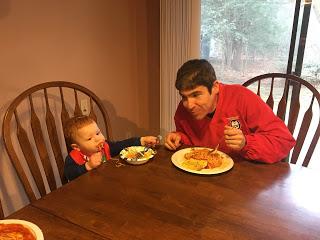
Carbo-loading with my boy!
Miles and Daddy enjoy a pre race pasta meal


With Dave and his dad, Larry, one of my first coaches
Dave Gaffin came to pasta dinner


Patriots Day: Race Day

Because last year they closed the road from 495 into Hopkinton, my dad insisted we leave early this time. Luckily, the roads were not yet closed and I was at the athlete's village by 6:45 AM. I was one of the first runners to arrive. As I entered, they made me dispose of a clear plastic bag because it wasn't the approved plastic bag. I had my socks, GUs, and Vaseline in the approved plastic bag. My shoes were wrapped in another clear plastic bag, which they let me bring in. My brother gave me hand warmers, so I gave the volunteers some of the extras, which they appreciated. After I entered, I found a pole that hadn't been claimed yet, tossed my heat blanket I had wrapped around me when I crossed the finish line of the Rock N Roll DC Marathon on the wet ground, and waited. To stay warm, I had an old jacket from my father, two old sweatshirts from my mom, and warm up pants. I had old shoes and shoes that I was ready to ditch. It was enough to barely stay warm.

Fellow DC Road Runner Joe Kane

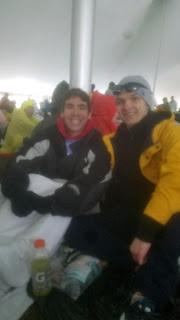
Joe from my running club found me sitting against a pole, and we killed time swapping running PRs, expectations for the race, and our future race calendars. The rain pounded outside - ice swept off the top of the tent and hurdled to the ground - and the wind was loud and steady. We chatted with a few other runners. Before it was time to exit the athlete's village, I ditched my old shoes and socks, put on my race shoes, and wrapped my feet in plastic bags to stay dry until the race. I walked in those plastic bags over a kilometer to the start line. Ten minutes before the start, I found Derek. Our plan was to pace each other like we had the previous Boston Marathons.

Miles 1-4 = 7:08; 6:56; 6:57; 6:50
The first half of the race didn't feel that great to me. The rain and wind was demoralizing early and often; it was too crowded (as always) to find my pace, so instead of worrying about pace, I settled into feel. I was only able to keep Derek in sight for the first few miles; he was gone after that fourth mile. Unlike in past races, I let him go and stuck to my own sense of what I could accomplish. I wasn't going to chase after him again.

Miles 5-8 = 7:08; 7:07; 7:06; 7:16
No matter how many people there were around me, I just could not find a group to draft off of - it was as if I was an island in the middle of a storm. Sure, I was never by myself, but I was never really with any group. There always seemed to be a gaggle of runners ahead and behind me and a few runners sprinkled in between the two. I didn't want to burn energy to catch and keep up with the front group; and I didn't want to slow to let myself be caught. I remember in Framingham remarking to another runner how utterly alone it felt. Perhaps that was also due to the fact that there were very few spectators, for Boston's standards. I don't blame them.

Miles 9-11 = 7:13; 7:17; 7:20
The rain and wind really was hitting me hard. Mentally, it wasn't enjoyable. I was in a bad mood at this point and thought, "Yet another Boston Marathon I won't be able to run a good race." "I will have to wait another year to try again." "I'm sure glad I ran Rock N Roll DC five weeks ago and broke three hours there rather than putting my eggs in the Boston basket again." This was my sixth Boston, and I felt like I just couldn't catch a break. My first Boston in 2012 was nearly 90 degrees (4:07); 2013 was decent weather but I ran out too fast (3:19); and I have had warm weather since (2014 = 3:29; 2016 = 3:17; 2017 = 3:15). When I started dipping into 7:20, I thought my race was ending, that I would end up in the 3:20s. At one point, I considered dropped out, briefly, before remembering I had to get to Boston and then to the airport to meet my parents to get my son and fly home. Dropping out would complicate my trip home.

Miles 12-13 = 7:16; 7:14
I think my race started to change as I approached Wellesley College and their famed "scream tunnel." I high-fived a few of the coeds and even a cop. I noticed how few of them there were compared to past years. But, when they were behind me, I felt better. Maybe it was the cheering, the encouragement, or maybe I just had enough of the moping and self-pity. I hit the halfway point and something happened - I stopped feeling bad and realized I had hit the half in 1:33:53 and was on pace for a sub 3:10. I knew that I was still on pace to BQ (my qualifying time is now 3:15) with room to spare. I took stock of my body and noted that my legs were strong, my form was intact, and suddenly I had a boost of confidence. I remembered my race plan: don't go out too fast (check), find my rhythm (check), get to the halfway point in respectable time (check) - and what lay ahead of me: take the Newton hills as they come and don't overexert myself, get to the top of Heartbreak Hill in good shape, and then race the final five miles or so. Now, it was time to execute the second half of my plan.

Miles 14-16 = 7:05; 7:08; 6:51
I felt really good from the half until the first of the four Newton Hills. I started to get excited and dialed in a few mental tricks. First, I remembered my email signature “Fate whispers to the warrior, `You cannot withstand the storm,’ and the warrior whispers back, `I am the storm.’” And I told myself over and over again that I am the storm! I even said it aloud to a fellow runner. And as I did that, my legs turned over faster, my mood was lifted, and I tuned into two songs in my mind: Portugal. The Man. Feel it Still for no real reason than I think I heard it on the radio that morning and repeated that I was never going to give up and never going to let you down - that's right, I was Rick Rolling!

Miles 17-18 = 7:19; 7:17
I handled the first two hills pretty well. The crowds, while thinner than normal, propelled me forward. I stayed within myself and thought of past years on these hills - all of which have blended together - and knew I was running these better than my previous five attempts.

Mile 19 = 6:55
That was a big downhill and around this point a spectator shouted that Desi Linden had won! I didn't know it then, but she had pulled herself from a bad mental place to a great second half, just as I was doing.

Miles 20-21 = 7:13; 7:47
I nailed Heartbreak Hill! As I climbed up the last two hills, a female runner was struggling while I felt pretty good. I tried to encourage her and told her Desi had won. After I summited Heartbreak, I was amazed that my legs felt so good. I couldn't believe I still had my legs after Heartbreak! I suppose I didn't trash them early in the race like so many others do in the opening miles down those early hills. And then, I said, five miles to the finish - let's race!

Miles 22-25 = 6:57; 7:05; 7:07; 7:13
I was racing again - damn the storm, full speed ahead! Never before had I been able to race the last few miles at Boston. Not only was I strong and running and sticking to my plan, I was passing roadkill along the way and that lifted my spirits higher. I was looking for Derek as I expected I would pass him. That gave me extra motivation - to track him down and pass him as he had placed ahead of me at every single Boston we raced together. Not this year I told myself!
A friend watching me finish
Mile 26 and final stretch = 7:29; 7:08 (.34)
My 25th mile was when I started to tighten up and slow. I lost my 3:07 because I couldn't run a sub 7. But, with a mile to go, I had 7:30 or so to get in under 3:09, so I got to work. With about 1K to go, I think I had 5 minutes to register a 3:08. And, soon, it was right on Hereford, left on Boylston, and sprint straight for the finish. I put down a 7:10 for my final mile, which got my my new course personal record of 3:08:36 and my first time qualifying for Boston at Boston. It was an amazing feeling... that quick faded when I stopped running because it was wet and cold and windy and I started to shiver and ache.

I limped a few blocks to my friend's hotel where he arranged for me to get in and use his shower. I had dry clothes there that I had given him the day before. I ran solidly and was very pleased with my race. On the T ride to the airport, there were a few other runners and some gave congrats. The exchange of my son at the airport went fine. We sat down at Boston Beer Works in the JetBlue terminal. A lady gave us her table so we could eat and she took a seat at the bar. I bought her a beer for her kindness. Miles and I shared a veggie burger and fries, and I enjoyed a beer while Miles enjoyed his sippy cup. The flight was delayed an hour due to the weather and he made me chase him all over the waiting area. Joe Kennedy, the current Congressman for my hometown, was on our flight. He came to say hi and I told him my son's hair was as red as his. After a long weekend, I was happy to finally get home. It was a successful trip and next year I hope that the weather for Boston will be perfect!

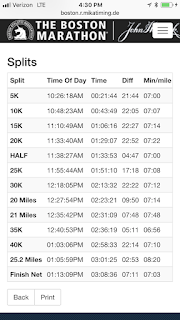
My splits
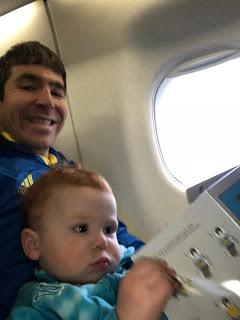
Flying home. Miles reads the safety pamphlet.
Sammy wears my medal.

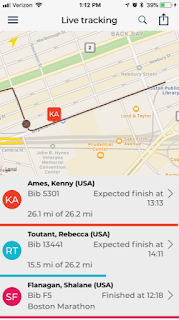
I had a friend live text while he watched the race. He referred to me as The Storm in these texts. It was informative to read these after the race:

Weird to see elite runners in long sleeves and winter hats.


Jordan Hasay, Salazar runner, decided not to run.

Conservative first 5K for you. I wonder how the weather is affecting everyone. 

Shalane had to make a portapotty stop but caught back up to the lead group.

Vail predicted finish of 2:12; leader is running a 2:10 pace.

Elite women are running a 2:39 pace. Must be misery out there.

Vail now predicted at 2:15; leader at 2:12. Rupp still in lead pack.

Ethiopian woman goes out to 45 second lead over Flanagan and rest of pack.

Judging by the elite times, this is going to be a slow race.

Elites still wearing their jackets and hats.

Yuki pulls away from lead men!

Vail fading, now at 2:17 pace.

Shalane and Rupp fading.

Kenyan back in charge.

The Storm less than 2 minutes back of Derek.

Vail predicted at 2:21; Rupp 2:15.

American Des Linden in front of the women's race now.

Linden putting the hammer down; gonna be first American winner since 1985.

The Storm gaining at 25K, running 7:08 pace.

Derek has given up the ghost. 7:56 pace at 25K.

Galen Rupp drops out, rumor.

Total downpour. Linden coming to the line! Yuki making it a race.

Nice to see the crowds still came out.

Yuki comes from behind!

Kenan Kirui bonked big time.

It's Yuki in in 2:16. He ran 12 marathons last year and this is his fourth in 2018.

Storm makes his move! Storm still running strong at 7:12.

Linden had slowed to help Flanagan get back in the race after Flanagan's potty break. Great sportsmanship!

Vail and Rupp both appear to have dropped out.

American women make up 7 of top 10, Flanagan in 6th.

Six American men in top 10, top is 3rd place Shadrack Biwott.

Storm still fighting at mile 21, 7:48 pace.

Storm is over Heartbreak and flying again, 6:56 pace to 35K! Derek at 7:57.

Last mile, bring it! BQ at BM!

STORM!!! STORM! STORM! Nice run in the adverse conditions!

Derek 3:16.


Final thoughts

I am very pleased to run another BQ in such tough conditions. This was my first BQ at Boston. I hope to never have to run in such terrible conditions again, but I will tell the story for a long time (of course, I'll take this over heat). I suspect my stroller runs and running to work with a backpack helped in my training. Of course, now I wonder how fast I could have run this year if the weather was perfect. This is my fourth BQ in a row and the best stretch of marathon racing in my career. I hope to keep the streak going as in June I'm registered for Deadwood in South Dakota and this fall I'm in for the New York City Marathon.

Splits: 7:08; 6:56; 6:57; 6:50; 7:08; 7:07; 7:06; 7:16; 7:13; 7:17; 7:20; 7:16; 7:14; 7:05; 7:08; 6:51; 7:19; 7:17; 6:55; 713; 7:47; 6:57; 7:05; 7:07; 7:13; 7:29; 7:08 (.34).

5k = 0:21:44; 10k = 0:43:49; 15k = 1:06:16; 20k = 1:29:07; Half = 1:33:53; 25k = 1:51:10; 30k = 2:13:32; 35k = 2:36:19; 40k = 2:58:33; Finish = 3:08:36; Pace = 7:12

Overall = 3070 (I beat my bib!); Gender = 2847; Division = 423

Thursday, April 21, 2016

Boston Marathon 2016 Recap

The factors I cannot control are the ones that seem to bother me the most. There was the sun at the start, making it feel like a 70 degree day to start the race. There was the headwind pushing me back the closer I got to Boston. And, there were um, stomach issues, the night before the race. So now that I have my excuses out of the way, let's talk about what happened at the 120th running of the Boston Marathon.

Someone took a candid of me as I entered Athlete's Village

Heading into the Boston Marathon, I was feeling strong and confident. I was coming off of some very serious personal bests, namely the Houston Marathon in January in 2:59:31 and the Rock N Roll DC Half Marathon in 1:23:54, plus a very strong course PR at my club's Langley 8K, a hilly and challenging course. I wasn't concerned with my poor showing at the GW Birthday Marathon Relay (we got second place with no shot of taking first or any real challenge from the third place team), my withdrawal from the Club Challenge Ten Miler due to tired legs, or my hamstring issue that forced me to take a couple of days off prior to our Ireland trip including my final true long run. When I stood in the starting corral, I felt pretty good. I knew a personal record was unlikely due to the temperatures, and coach and I agreed that I should keep my pace between 6:55-7:05, aiming for a 7 minute pace. That would have given me a 3:03/4 and a huge course PR and another BQ. In retrospect, I probably would have been better served holding a 7:10-15 and aiming for a 3:10.

The day began early as my father drove me to the start in Hopkinton. We left by 6:10 and he dropped me off a few blocks from the runner's village around 6:40, plenty of time for him to get back on 495 before they shut the road. I vowed to spent less time on the course than I would spend in Hopkinton waiting for the race to start. 3:17 < 3:20 so mission accomplished. I found a spot in the sun and laid down and relaxed. I chatted up with a guy near me, Chris, who ran with Capital Area Runners. This was his second Boston and third marathon. At 8:30, I met Derek Bailey, my friend from Houston, by the "It all starts here" sign. We exited the village, headed down to the starting line in our corral, and waited.

Derek and I devised a plan to race together. For the first few miles, we were talking to each other, getting into our rhythm, and grabbing each other water. I went over the plan which was to hold on to a 7:05 pace, nice and easy, survive the hills intact, and make a go for it the final five miles. We mostly stayed together in the first 10K, but I had to run my own race. In my head, I told myself to get through the first ten using my head, the next ten using my legs, and finish strong using my heart (the final 10K). The first ten went according to plan, and the plan stayed mostly true until the Newton hills. Someday, I'll be fresh when I hit those hills, but Monday wasn't that day, and rather than waste myself trying to maintain pace, I climbed them trying to just keep moving forward.

In the past, I knew I wouldn't have a good day in 2012 when at the 10K, it felt like the 20 mile mark in that almost 90 degree heat. In 2014, I think I made it to the ten mile mark before I started to negotiate with myself as I backed off the pace. This time, it wasn't until mile 16 when I knew coming in under 3:10 wasn't going to happen. I know they say there are four hills in Newton, but I somehow counted six. At the top of Heartbreak, I felt some freshness return to my legs and thought about picking up the pace. But, given that 3:10 was no longer realistic, I lost my motivation to put myself through any more struggling. I certainly didn't quit, but I didn't have the same positive view I had in Houston in the final miles. I'm confident that had one of my time goals other than to set a course PR been achievable, I could have willed myself to push it

What kept me going the final few miles was looking forward to seeing my family at Coolidge Corner. We scouted a spot on Saturday at the corner of Beacon and Harvard, so I knew exactly where to look for them. As I approached, I slowed to kiss them and say hi and demand a picture. My wife pushed me away, worried about my time, but you can see that in this video my father shot. They were just before the Mile 24 marker, and I left them at right around 3:00:00 on the dot, so I knew I could do about two and a quarter miles in less than twenty minutes, perhaps as quickly as 17 minutes. With my mind set on 3:17, I tried a few surges and with one mile to go, I had 7:30 to break 3:18. My watch had me on 7:30 ish pace for most of the mile, but when I turned left onto the final straight-away, I entered the pain tunnel and pushed my body across the finish line with time to spare. A 3:17 and a new personal course record!

After, I wobbled through in a daze, freezing as the wind had picked up and there was no more sun since the buildings blocked it out. I met my friend, went back to his apartment for a shower and change of clothes (gave them to him Sunday at the expo), and took off to the T (Back Bay to State and transfer to Blue to the airport and then a shuttle bus to the C Terminal). At the airport, my father and wife picked me up, we got food nearby in East Boston and a beer, and then we were onto the airport. I had time to sit at Boston Beer Works before our flight home to DC.

I received the following official email from the Boston Athletic Association:

Your finish time is listed below.
Kenny Ames
Net Time3:17:49
Overall4442/26639
In Gender3870/14471 (Male)
In Division2309/4807 (M18-39 Age Group)

This gives me a chance to compare my results of my four Boston Marathons:


2012 - Bib # 4186
22:44 5K; 46:14 10K; 1:11:24 15K; 1:38:09 20K; 1:44:55 Half; 2:08:07 25K; 2:41:38 30K; 3:17:14 35K; 3:52:47 40K; 4:07:40 Finish. 10122 Overall; 6956 Gender; 2947 Division.

2013 - Bib # 4935
21:47 5K; 42:58 10K; 1:04:27 10K; 1:26:46 20K; 1:31:46 Half; 1:50:18 25K; 2:15:15 30K; 2:41:14 35K; 3:08:03 40K; 3:19:41 Finish. 5774 Overall; 4962 Gender; 2730 Division.

2014 - Bib # 6304
21:51 5K; 43:33 10K; 1:05:32 15K; 1:29:48 20K; 1:35:00 Half; 1:54:55 25K; 2:21:42 30K; 2:49:37 35K; 3:17:49 40K; 3:29:06 Finish. 9029 Overall; 7076 Gender; 3311 Division.

2016 - Bib # 4174
22:11 5K, 44:16 10K, 1:06:26 15K, 1:29:07 20K, 1:34:02 Half, 1:51:59 25K, 2:16:13 30K, 2:41:58, 35K, 3:07:43 40K; 3:17:49 Finish. 4438 Overall; 3866 Gender; 2309 Division.

I know I am getting better and smarter as a runner, but I would have had a faster race if I set my goal to 3:10 instead of 3:05. I should recognize I do not fare well in heat, especially if I have not had a chance to acclimate. Hopefully, future races give me the perfect 45 and overcast weather where I thrive! On to the next one...

Monday, January 25, 2016

12 Weeks to Boston

It is amazing to think that the gloves I am wearing to shovel the snow were worn last week, just a few days ago, at the Houston Marathon.  I'm quite fortunate the storm did not come earlier or I would have either not been able to fly to Houston or would have chosen not to go as I am not about to leave my wife home by herself for this.

This is what two feet of snow looks like.

The storm has forced me to take two consecutive days off from running - something I hadn't done in quite awhile.  I think it was actually beneficial as it gave me rest from the personal best and helps me recover so I can begin the next training cycle strong.  My goal is to replicate my feat at Boston on April 18.  Instead of running on Saturday and Sunday, I shoveled.  A lot.  Five shifts of ninety minutes over the two days to dig out our walkway to the main street, a path around the house to the trash and alley, clear the deck from snow so it doesn't ruin, and clear off cars.  The walkway was cleared from my attached neighbor's house (on our left as we look at 17th Street) all the way to Monroe Street.  With my neighbors on the right, the six of us cleaned the walkways and dug out many cars.

This is how you clear a sidewalk - not a path, the entire sidewalk!

This morning, I went for a run along the road next to Catholic University and then we went down the MBT.  The MBT had sections that were fine for running toward the head of the trail as we went past Rhode Island Avenue, but when we hit the bend and passed under New York Avenue, the path wasn't cleared and the footing became treacherous.  I ran with Shawn and we agreed that we would stick to the paved roads.  I also have not done any strength training or yoga, but if I do not do them for another week, that won't be an issue.

The path from the front to the backyard.

I communicated with my coach and we planned out most of the workouts for the next twelve weeks.  Nothing is foreign or new.  We will use some club races including Langley 8K, the Club Challenge, and the George Washington Marathon Relay.  We will also use the Rock N Roll USA as a preparatory race.  With our vacation to Ireland in March, we'll have to schedule accordingly.  Otherwise, I am hopeful that I can get into the kind of shape that will get me from Hopkinton to the finish in Boston in less than three hours - weather and more factors cooperating, of course.
The path to the alley.

Our back porch.


Thursday, December 31, 2015

Running Recap of 2015

2015 was arguably my best year so far.  In addition to running the most miles in a calendar year - over 3076 miles in over 420 hours according to Strava - I added yoga to my routine and revamped my strength training exercises.  I started training with a new coach, Ryan Vail, who added more speed during my long runs (tempo-long-tempo, fast finish, and Hansons Brothers workout.  We also got away from the track (mostly) and replaced it with longer tempo workouts.  Below are a few numbers to quantify 2015:

Miles run = 3076 (previous high = 2500)
New 5K PR = 18:22 (previously 18:34)
Fourth overall in Langley 8K
First place DCRRC Snowball Series age group 35-39
Second overall Prospect Park Spring Run (Bachelor Party weekend in Brooklyn)
Set then PR New Jersey Marathon = 3:04:01
First place age group and ninth overall Mad Marathon in Vermont on my 38th birthday
Course PR Leesburg 20K = 1:23:53
Set PR = 3:00:58 at Bismarck, ND Marathon and finished first age group and seventh overall
Course PR = 3:12:47 at NYC Marathon
Second place age group Morris Township Turkey Trot 5K = 18:31
Broke 40 on the tough Bread Run 10K

I added three more states towards my 50 state goal.
Completed = CA, VA, MD, PA, OH, NY, RI, ID, GA, MA, MN, UT, WV, DE, MI, AL, WA, IL, OK, NJ, VT, ND.  So far for 2016, I am registered for Houston and Boston.  I haven't picked my other marathons just yet.

2015 was indeed a great year for running, and I am hopeful for 2016 to be a solid year as well.  Next up is the Houston Marathon on January 17, 2016.

Thursday, April 17, 2014

Ready for Boston!

I haven't been able to write as much as I would have liked because I have been finishing up my master's thesis.  I turned it in on April 2 and now I wait for comments from my reviewers; the defense is likely May 5.  It's title Social Media #FTW!: The Influence of Social Media on American Politics.  Message me if you would like to read it.

This week, I'm preparing to run the Boston Marathon.  It's an exciting day as the Commonwealth of Massachusetts takes the day as a holiday and the Red Sox have their 11:05 AM start of a game.  I'm optimistic that it can be my fastest Boston to date based on some solid winter training and two recent personal bests in other distances.  I have raced well lately, in my opinion.  In March, five weeks before Boston, I ran the Rock N Roll USA Half Marathon in DC in 1:25:47 - 15 seconds better than my previous PR.  The course was hilly so I think I had a faster time in me on a flatter course.  In early April, two weeks before Boston, I ran the Cherry Blossom Ten Miler in 63:11, blowing away my previous PR of 64:00 (on a course that was likely short).  I also had a good race at the Club Challenge, which is a notoriously difficult course with lots of challenging and long hills.

I didn't work with my coach this winter since I had too much on my plate (see thesis) so I trained myself.  Since it was a snowy winter, I relied on hill repeats instead of track which was likely icy.  The good part about hill repeats is that if there is a little ice or snow, you can still finish the workout.  I would run a longer warm up, like 6 miles, then do the hill repeats to practice for the hills of Boston that hit between miles 19-21.  I also did a long run of 16 miles around 7:30 miles then the following day raced a 10K so that I would practice racing while tired - again, preparing for the final miles of Boston.    In the two weekends between the half marathon and Cherry Blossom, I ran 22 miles as my long run and 21 miles the following weekend, each averaging a bit faster than 7:30 pace.  Physically, I am ready for this race.

Mentally, I think I am ready as well.  I have a lot on my mind.  Last year's Boston Marathon still echoes in my thoughts.  I truthfully have no idea how I will feel; my family and I were out of the city by the time the bombing occurred.  I know it will be emotional.  The recent passing of my mentor, Arnie Thomas, is weighing on my mind.  Last year, I ran in memory of two of my uncles that passed away in 2012.  I'm sick of running this race in memory of people I care about deeply - please let's not have anymore losses, okay?

I will try to use all this motivation in a goal of doing my best.  My A goal for the day is sub 3 hours; my B goal is sub 3:04 (which would be a PR); my C goal is sub 3:08 (to qualify for next year); and finally, if all else fails, I want to beat my time from last year of 3:19.  I have read and re-read the Sports Guy's article on the Boston Marathon, which I enjoy reading each year.  I'm looking forward to seeing my family.  I have been tapering while observing Passover, and it should be interesting to carbo-load without eating pasta or bread (I'm relying on potatoes, bananas, apples, and yogurt).

The 2014 Boston Marathon is only days away - I can't wait!!

Monday, November 18, 2013

Comparing Red Sox Managers' Leadership Skills

For my leadership class toward my MA in Government, our assignment was to compare two current leaders.  I chose Red Sox skippers Terry Francona and John Farrell.  It really doesn't tie to this blog on running unless you could the running players have to do around bases.

            “Swing and a ground ball stabbed by Foulke.  He has it.  He underhands to first.  And the Boston Red Sox are the World Champions.  For the first time in eighty-six years, the Red Sox have won baseball’s world championship.  Can you believe it (Castiglione 2004)?”
“It hasn’t happened at Fenway Park for ninety-five years!  The Red Sox are World Champions! (Buck 2013)”
The Boston Red Sox have been crowned champions three times (2004, 2007, 2013) in the last decade after a notorious drought that lasted eighty-six years.  This success was made possible due to solid leadership, a shared vision, and the right fits at manager who could communicate the blueprint from ownership to the players.  In 2002, John Henry led an ownership group, including Tom Werner and Larry Lucchino, that purchased the franchise from the Yawkey Trust, and the new ownership changed the culture immediately.  Recognizing the importance of instituting a manager who shared their vision and commitment to winning, Terry Francona was brought in to manage the team in 2004.  Francona won twice but departed after eight years and Bobby Valentine succeeded him.  Valentine was fired after one season in which the team didn’t win seventy games in part due to his deficiencies as a leader and inability to communicate.  To replace him, the ownership recognized the club needed a manager with similar qualities to Francona and brought in John Farrell.
In baseball circles, many often wonder what impact a manager can have on his team.  Some believe that a strong manager can make the difference between winning a title and missing the playoffs.  Others believe that managers would do best to get out of their players’ way to let them just do their thing.  Since these two Red Sox skippers brought these nine (baseball-speak indicting the ball club) to the top of the sport, it is appropriate to compare Terry Francona and John Farrell by examining their leadership styles according to Kouzes and Posner’s Five Practices of Exemplary Leadership: Model the Way, Inspire a Shared Vision, Challenge the Process, Enable Others to Act, and Encourage the Heart (2006, 13).
Model the way: Titles are granted, but exemplary leaders know they must be models of the behavior they expect of others because leaders model the way (Kouzes and Posner 2006, 14).
Being named manager bestows a title, but it is up to the leader to earn respect and influence to wield power gained.  Both Francona and Farrell set the examples for their charges, and players wanted to play for them and would go the extra mile.  Francona had a reputation as a player’s manager who would protect his guys and never embarrass them.  While Francona was being considered for the job, Red Sox General Manager Theo Epstein was pursuing Curt Schilling, a Cy Young winner who formerly played for Francona during his first MLB managerial stint in Philadelphia.  Originally, Schilling wasn’t considering joining Boston until “word leaked out that the Red Sox were interviewing Terry Francona as Grady Little’s possible replacement, Schilling decided he might be willing to go to Boston after all (Mnookin 2007, 243).”  Schilling became a clubhouse leader and courageous follower of Francona’s.  He shared Francona’s goal of bringing a title to Boston, taking on the challenge and inspiring his teammates, most famously by pitching and winning in the playoffs with a surgically secured ankle.
The Sox ownership wanted a manager who would be a partner and not a middle manager.  The right fit would, according to Epstein, “Embrace the exhaustive preparation that the organization demands, and Francona quickly emerged from the applicant pool.  His experiences gave him a remarkable understanding of our vision.  His preparation, energy, integrity, and communication skills are exceptional (Shaughnessy 2005, 39).”  Schilling was also known for thoroughly studying opposing hitters, and because Francona modeled the way, players prepared seriously and that contributed to on-field success.
After the collapse of the 2011 team, which squandered a nine-game lead in September failing to make the postseason, ownership elected to part ways with Terry Francona.  They replaced him with Bobby Valentine, whose style was very different.  Where Francona would go out of his way to protect his players, Valentine would publicly call out players, embarrassing them and calling attention to internal discord.  Valentine verbally sparred with fan-favorite Kevin Youkilis, calling him out for poor play at the beginning of the season causing a rift that he never mended.
Recognizing their mistake that resulted in a contentious 2012 season under volatile skipper, Bobby Valentine, and seeking to restore the kind of leadership displayed by Francona, new Red Sox General Manager Ben Cherington hired John Farrell.  “The Farrell regime represented a return to Francona’s style.  It’s only natural.  John Farrell and Terry Francona were big league teammates with the Indians.  They were great friends.  Their wives and kids were friends.  Francona brought Farrell to the Red Sox as pitching coach for four seasons (Shaughnessy November 2013).”
Farrell understood the importance of laying out clear personal values and setting the tone.  During a spring training interview with the New England Sports Network (NESN), Farrell explained his views on leadership: “I think the thing that stands out about a leader is how he goes about his work.  It’s not so much what he says.  It’s the example that he provides for a starting pitcher.  For instance, what he does in-between starts to prepare for that fifth day.  What is the daily routine for a Shane Victorino, a David Ross, or a Stephen Drew at shortstop – guys that have been added to this roster?  It’s more about keeping that game the focal point and every preparation step along the way that’s needed to put them in a position for success tonight (Farrell 2013).”  Farrell understood that the players would take their cue from him.  He needed to display his dedication to putting the team in a position to win, and the players would follow. 
Inspire a Shared Vision: To enlist people in a vision, leaders must know their constituents and speak their language (Kouzes and Posner 2006, 15).
Terry Francona had to display that he could communicate in an appropriate manner with his players early on in his tenure.  At the beginning of his first spring training in Boston, there was the annual big meeting to kick off the season where ownership, the general manager, manager, traveling secretary, public relations director, equipment manager, and a representative from the Red Sox Foundation addressed the entire ball club.  This provides the organization with a shared vision for the year while plotting out strategy and mission.  The meeting was to begin at 9:00 AM, but as time approached, Francona noticed Manny Ramirez wasn’t there.  Ramirez was known for being absent-minded and acting out at times, giving birth to the phrase, “Manny being Manny.”  If Ramirez missed this meeting, it had the potential to create a press firestorm and torpedo the new manager.  Francona recruited the affable and popular designated hitter, David Ortiz, who is affectionately called Big Papi by teammates and fans and is a friend of Ramirez’s, to go get him.  Ortiz recognized the situation and respected the way Francona wished to handle this, opting to let a player bring another player to the meeting to avoid making a scene.  The next day, Ramirez approached the manager during spring training drills, draped his arm around him, and said, “I’ll hit third, I’ll hit fourth, I don’t care.  I’ll do whatever you want. (Francona and Shaughnessy 2013, 77).”  This reaction showed that Ramirez valued the way the new manager’s style.
Francona avoided a pitfall by appealing to Ortiz’s shared aspirations.  He let a friend bring Ramirez rather than potentially embarrass the temperamental All-Star.  Farrell also believes in this approach and has had the chance to display it.  A few players lost focus during Francona’s final season with Boston, creating a press storm when they were rumored to be eating chicken and drinking beer in the clubhouse during games.  Their performances suffered, but they were still talented pitchers.  Farrell was able to inspire them to return to a solid workout regimen that produced wins and a low staff ERA.  He earned their trust and respect by appealing to shared aspirations of greatness.
Red Sox Chairman Tom Werner: “John has demonstrated extraordinary leadership ever since he became our manager last winter.  John has the team focused on winning, the clubhouse is happy, and the players grind out at-bats.  His skills range from his calm nature to his in-game strategy.  Whether communicating with our core group of stars or the role players coming up and down from Pawtucket, he has everyone’s trust (Shaughnessy July 2013).”
Challenge the Process: Leaders venture out and are learners.  They learn from mistakes and seek ways to change, grow, and improve (Kouzes and Posner 2006, 17).
The Red Sox ownership rely on a type of data-driven statistics known as Sabermetrics, a methodology popularized by Bill James and expanded upon by the publication Baseball Prospectus.  Not all managers subscribe to this forward-thinking approach; some rely on old-fashioned trusting one’s instincts, eschewing data.  The Red Sox needed to make sure their managers shared and conveyed their approach to the players.  “Francona seemed to intuit the need to combine a deft interpersonal approach with the utilization of as much information as he could possibly get his hands on.  It was clear that Francona would never eschew the detailed reports the team put together (Mnookin 2007, 247).”  Francona and Farrell bought into this innovative approach and succeeded by playing the percentages, which is the heart of what Sabermetrics is.
Both Francona and Farrell had previous managerial jobs in the majors, and both struggled initially.  Francona had four mediocre seasons managing the Phillies in the late 1990s.  But, he learned from his mistakes and was able to use that to his advantage in Boston.  “Francona’s pliability, a flaw in Philadelphia, would be an asset in Boston, where it was reframed as a willingness to learn and grow (Goldman 2005, 29).”
In his first season Philadelphia in 1997, Francona sought to change the direction of his club which he did midseason in a closed door meeting: “He blasted his team – and they promptly won thirty-eight of their last fifty games.  Francona was applauded for his handling of the situation and his ability to motivate a team that had little viable pitching after Schilling and a mismatched roster (Goldman 2005, 27).”
Farrell also failed in his first managerial stint in Toronto.  The Blue Jays were dismayed with his performance after two years and willing to let him go to the Red Sox.  But, he learned from those seasons and applied the lessons to his leadership approach in Boston.  Red Sox second basemen Dustin Pedroia, a former Rookie of the Year and American League Most Valuable Player: “The thing with John is he’s so smart.  I think it seems like he learns from every single person he’s around in baseball.  John has been unbelievable with all of us, just the communication (Ulman 2013).”
Also, Farrell showed strong leadership during the World Series by admitting he made a crucial mistake during Game 3 that possibly cost the Red Sox the game.  In the top of the ninth with the game tied at four runs apiece, Farrell failed to initiate a double-switch at first base and pitcher electing to allow the pitcher to hit.  The Cardinals won 5-4 in the bottom of the ninth on an obstruction play.  After the game, he conceded, “In retrospect, sure, I would have liked to use a pinch hitter (Ulman 2013).”  Down two games to one after the loss, the Red Sox won three straight to win the World Series.
Enable others to act: Excellent leaders foster collaboration because they know that trusting others pays off.  They understand that those under them are expected to produce results and that they must feel a sense of personal power and ownership (Kouzes and Posner 2006, 18).
Francona established a trust system by empowering his players and promoting cooperative goals.  He treated the players as men, yet made clear what he expected of them: “I put the rules out there each year to protect myself.  I wasn’t going to check curfew.  No manager does.  But if somebody did something stupid at night, I could say, ‘This is the rule.’  It was all just basic commonsense stuff: be on time, be respectful, play your ass off (Francona and Shaughnessy 2013, 76).”
An example of how Francona built trust was how he handled his first game as skipper.  In the 2004 Red Sox season opener, ace pitcher and part-time prima donna, Pedro Martinez, did not have his best stuff and took the loss in Baltimore.  In a huff, he left the ballpark before the game was over, infuriating Francona.  However, it is not his style to call out players publicly, especially on his first night on the job.  Yet, he managed the situation deftly by telling the press, “In all fairness to [Martinez], and everybody else, that [rule about leaving early] wasn’t conveyed correctly on my part, and I take responsibility for that (Francona and Shaughnessy 2013, 83).”
“Francona made it a point never to criticize any of his players in public.  If harsh words were uttered behind closed doors, no one heard about it (Shaughnessy 2005, 81).”  That was Francona’s modus operandi: when Sox players misbehaved, he addressed it inside the clubhouse and then diminished the indiscretion to the media.  This style has earned him the perception as a player’s manager because they trusted he would make them look good; the team appreciated his fostering of collaboration by taking the blame.
Farrell operates in a similar manner and that has helped him build a strong relationship with his coaches.  Like Francona, he does not seek attention by criticizing his players or coaches outside of the clubhouse.  An example of how he shared power is on display with his pitching coach, Juan Nieves.  While Farrell served as pitching coach for Francona, he hired Nieves for the role and stays out of his way to let him do his job.  Some leaders can have a tough time relinquishing a role they served prior to their promotion, creating a difficult situation when supervising the new incumbent.  Yet, Farrell respects Nieves and lets him handle the pitchers: his faith of placing his trust in Nieves has been rewarded through a 3.79 staff earned run average, nearly a run less than the 2012 Sox and Boston’s best in eleven years (Ulman 2013).
Encourage the heart: The climb to the top is often arduous and long so people can become exhausted, frustrated, and disenchanted.  Leaders recognize the temptation to give up yet encourage the heart of their team and celebrate success through a spirit of community (Kouzes and Posner 2006, 19).
In the 2004 American League Championship Series, the Boston Red Sox found themselves down three games to none to their hated rivals, the New York Yankees.  No team in baseball history had ever won a best-of-seven series when trailing by such a deficit; in fact, no team had ever rallied to force a Game 7.  Francona kept the team in a positive frame of mind and only thinking about having to win one game at a time rather than focusing on the daunting task of taking four straight.  He avoided the appearance of panic by ensuring his players saw that he wasn’t doing anything differently.  Although his stomach was churning, he knew that when things are getting out of control, players take their cue from the manager.  It was important that he appeared calm and focused: he wasn’t going to give them an excuse to quit.  He told the press after dropping Game 3, “We’re going to show up tomorrow and try to play one pitch at a time, one inning at a time (Francona and Shaughnessy 2013, 112).” 
And the players responded with optimism.  First baseman Kevin Millar told everyone, “Don’t let us win tonight.  If we win, we’ve got Pedro going tomorrow, then Schilling, and then anything can happen in Game 7 (Francona and Shaughnessy 2013, 113).”  Schilling handed out shirts that read, “Why Not Us?” referring to their chance to make history.  And the Red Sox did make history by winning the next two at Fenway in extra innings, winning Game 6 in New York with Schilling pitching on his bad ankle, and blowing away the Yankees in the clincher in Yankees Stadium en route to the title.
John Farrell was brought in to change the direction from the disastrous Valentine era.  “Farrell has brought leadership and dignity back to the corner office at Fenway and the Red Sox at the All-Star break have more wins than any team in baseball.  He has brought back the Tito style of putting the feelings of the players ahead of everything else.  And it is working magically (Shaughnessy July 2013).”
Farrell was able to encourage the team in the way the veterans still on the team were treated by Francona.  Red Sox pitcher Clay Bucholz recalled, “It’s almost exactly the way it was back then [under Francona].  This is the way our clubhouse used to be.  Players get treated with respect, like a professional.  That’s the way it should be (Shaughnessy July 2013).”  Farrell showed his appreciation for individual excellence and that recreated a spirit of community that Francona had built.  He acknowledged the role Francona played, “He taught me a lot.  He has a keen intuitive feel for the game (Shaughnessy November 2013).”  Once restoring that blueprint, Farrell was able to guide the team from worst to first.
Conclusion: Terry Francona and John Farrell are very similar in their leadership styles and personalities, and both accomplished the ultimate goal of a Major League Baseball manager: to guide their ball club to a World Series triumph – and they did it in their first seasons in Boston.  Professional baseball is a multimillion-dollar enterprise; so employing the right manager to direct a clubhouse of twenty-five talented and competitive men is crucial.  This season, Francona returned to the dugout as manager of the Cleveland Indians, his first year back as skipper after his Red Sox days ended.  He guided a club back to the playoffs for the first time since 2007, and the Baseball Writers of America selected him as American League Manager of the Year.  He beat out John Farrell, who came in second; but the Red Sox and Farrell can console themselves with their eighth title in franchise history and the comfort of knowing solid leadership has been restored.
Sources

Buck, Joe.  Announcer for the World Series.  Fox Sports.  October 30, 2013.

Castiglione, Joe.  Announcer for the World Series.  WEEI.  October 27, 2004.

Farrell, John.  “Spring Training Interview on Leadership.”  NESN.  March 30, 2013.
Francona, Terry, and Dan Shaughnessy. Francona: The Red Sox Years. Houghton Mifflin Harcourt.  2013.

Goldman, Steven, ed. Mind Game: How the Boston Red Sox Got Smart Won a World Series, and Created a New BLueprint for Winning. Workman Publishing, 2005.

Kouzes, James M., and Barry Z. Posner. The leadership challenge. Vol. 3. Wiley. 2006.

Mnookin, Seth. Feeding the monster: How money, smarts, and nerve took a team to the top. Simon and Schuster. 2007.

Shaughnessy, Dan.  “Indians’ Terry Francona over Red Sox’ John Farrell for American League Manager of Year a shocker.”  The Boston Globe.  November 13, 2013.
Shaughnessy, Dan.  “John Farrell proves right man for the job in guiding Red Sox.”  The Boston Globe.  July 15, 2013.
Shaughnessy, Dan. Reversing the Curse: Inside the 2004 Boston Red Sox. Houghton Mifflin Harcourt. 2005.

Ulman, Howard.  “Manager John Farrell’s steady leadership brings Red Sox from last place to World Series.”  The Associated Press.  October 30, 2013.