Showing posts with label Red Sox. Show all posts

Tuesday, April 23, 2019

Quitting Is Habit-Forming, So Never Quit


Matt's first Boston Marathon - with our brand new matchy-matchy jackets!


Moments after I crossed the start line of the Boston Marathon, my leg wasn't feeling right. In that first mile, I hoped that the pain I was feeling was going to dissipate. In the second mile, I knew the pain was real and wasn't going away. As I watched my friends hold onto our pace while I faded, I felt scared, doubt, and anger. The 11th hour injury I suffered to my lower left leg on a training run 10 days out was going to keep me from running the pace I wanted. It might have kept me from even finishing. In those early few miles, I was genuinely scared that I was going to have to drop out of the race.

The Ames Brothers ready for Boston Marathon


Let's go back a few. With three weeks to go, I broke in a new pair of running shoes on a hilly tempo run up and down Greenbelt Park with Mike and Alex. After the run, while playing with my son at a playground, I felt pain in my left foot and near the ankle. I went to the podiatrist who said the pain in my foot was just a bruise and it was okay to keep running. I thought I dodged a bullet and continued to train. With 10 days to go before Boston, I went for a tempo run in Philadelphia along the Schuykill River. Everything seemed fine. On Friday night after work, while walking my son home, I started to feel pain in my lower left leg. It seemed to come out of nowhere. On Saturday, I ignored the pain and went on a two hour run, my last long run before the race. My leg really hurt, but I was in denial since I was able "deal" with the pain. I took off the next day. Then the next day. Then, I decided just to take the whole week off to let it heal. I was icing it and taking naproxen and applying BioFreeze. While away on my work conference, I was icing it every chance I had, storing my ice packs in the hotel's freezer (the staff were great!). By Friday, the pain had gone down a lot. I was convinced that it would be fine on race day. I didn’t sleep well the last few nights before Boston. Thursday night, I slept in a hotel bed since I was on work travel. Friday I was anxious because we were driving to Boston early in the morning (6AM wake up in hopes to hit the road by 7 to arrive by 3PM). And Saturday night, my dog was up scared and confused since we were at my folks' house and not her usual routine.

Bib pick up with Derek


I went into Boston with my brother on Sunday to pick up our packets. It was his first Boston Marathon, and I was so proud to be there with him as we picked up our bibs and bought the jackets.

Bib pick up with Matt


I let a woman selling something apply some tape to my foot. It had no effect, so I took it off before the race. After our traditional pasta dinner, I went to bed on Sunday. I didn't sleep that well either and ended up on the couch so as not to disturb others.

Bib pick up with Derek and Matt


In the morning, we picked up my brother and my dad dropped us off at the start line in Hopkinton. It was pouring and the wind blowing hard - it knocked a tent over that blew into the both of us. I worried the tent may hurt us, but we were fortunate. We waited in Athlete's Village for two hours while the rain and wind battered the big tent. I interviewed him for his charity's fundraising page. I had made plans to meet others, but they moved the "It All Starts Here" sign, so the directions I gave them were wrong. We did all finally meet in the corrals. The race began, we took off, and minutes later, I knew I was in trouble.


A wet and windy morning in the Athlete's Village. Since we were among the first to arrive, we got a spot against a pole.


I actually considered dropping out in the first 5K (25% serious / 75%) against. I have a friend in my running club who has the same brain cancer that Ted Kennedy, Beau Biden, and John McCain had. I thought of her and the idea of quitting disappeared. Soon, I found a group of other 3 hour marathoners between the waves who were the "running wounded." Mike from Utah and Ryan from North Carolina became my running team that day. Running with them helped get my mind into the positive, and I started to focus on what I could do, not what I couldn’t do. Running with others in your boat is a huge emotional boost as I don’t know if I would have gotten out of my hurt thinking alone. We joked about our injuries, shared stories about what should have been, compared QT times and races, shared stories of our kids, and just kept the other going. We were from different backgrounds and parts of the country in different fields, yet there we were with one thing in common: we could run fast marathons, just not today. We started to make light of our situation, and it was around then I was determined to finish. We were a running punchline: a Jew, a Catholic, and a Mormon were running Boston all injured...


I noticed something else while running with them. Being in the void that is between the waves, each fan could concentrate on us and devote energy to calling our name, number, or club in support. “Go DC with the Sawx hat!” In fact, after the half, my leg was not painful, just a discomfort. I knew my split (1:43:46) and knew I could do that again. Once I was confident of finishing, I felt a surge carry me forward. Then wave 2 caught us before the Newton hills. But not too many runners, just a few speedy people that probably had slow qualifying times but were actually fast enough to be in wave 1; they left us behind. That's when my competitiveness kicked in. Then Mike took off to go say hi to his wife with a promise to find me. I had promised to at least stick with him over Heartbreak since that’s where his race fell apart last year. While he was gone, I caught up to one of my club mates. I had seen her in the small tent in the village prior to the race and knew she was battling a leg injury that cropped up recently. We ran the first hill together over 128 and stayed together until the hospital when she told me to go. She HAD to finish as getting to the finish line guaranteed her streaker status (10 Boston finishes in a row). I later learned that she did indeed finish, probably much slower than she would have wanted. That was true for me as well.


As we parted, Mike found me again. Thanks to Shawn kicking my ass up the hills of Brookland and the Capitol, I was in great shape and made very good time. I was even smiling and pointing at fans. One fan had a sign that said "Straight Outta Boston." I replied, "You mean Straight Into Boston!" I was able to let myself have fun, I pumped my fists, and I even asked the score of the Sox game. “Are you a Red Sox fan?” I asked people in the crowd wearing a hat or shirt. “Yes!!!” was their answer. “What’s the score?” Not one person knew to their shame. I spent the rest of our time together trying to convince Mike we are diehards. He chalked it up to they are such good race fans they didn’t check their phones.


My best 5K of the race was after the last hill. That’s when I had my fastest mile of 7:06. I had energy and figured I wasn’t going to do any more damage. And it was warm now so I had a lot of roadkill serve as rabbits. As bad as I felt, I was better off than the dude by mile 16 with a bib in the 1000s carted away in a stretcher or the guy at 23 sitting dazed unable to talk to medics. My thighs did tighten the last mile or so. I think that was due to how I had to compensate my gait. I took the final two turns raising my arms, blowing kisses to the fans, pointing to the B on my visor, and just being happy to finish. Then I realized if I ran a solid final sprint, I could claim 3:23 and I did by a few seconds. I saw Meb at the finish. He gave me a fist bump. He had a medal and I looked at him like "okay, put it around my neck." He said it was for someone else. After a few more steps, my dad spotted me and we took a picture. I connected with Shawn and regretted I had no more in me to make the mile trek and back to his house. I found Alex for a picture and congrats and rejoined my dad at a bar my the finish line. When my appetite came back, I joined Dad and Jen at the Charles Mark hotel Parish Cafe by the finish line. We could see the blue boards holding up the finish line. We drank beers and ate pizza along with my sister-in-law until my brother finished. I videoed him finishing the race - it was awesome to watch him finish his first Boston!


Moments after finishing with my dad


While not my best (or worst) time in Boston, I am grateful to have finished. I am beyond proud of my brother! Every picture of him running, he has a big grin on his face. Now, it is time to recover, rest, and heal. I am going to take it easy so I can make a go in Green Bay on May 19, or at least finish to collect another state.

Checking in with the wives while waiting for Matt to finish


My splits:


5k 0:24:10

10k 0:49:26

15k 1:14:16

20k 1:38:27

Half 1:43:46

25k 2:02:54

30k 2:26:55

35k 2:50:37

40k 3:13:42

Finish 3:23:54

Finish Pace 07:47

Overall 7486

Gender 6095

Division 1102

My Adidas video of the race

I gave my wife my medal for being so supportive and giving me best advice: you better be able to walk on vacation! We had a nice getaway in the Berkshires the three days after the race. It was our first time away from our son who had a blast with my sister and her family. On the drive, we stopped at a rest stop in Blandford, MA. We saw half a dozen Japanese tourists wearing their Boston Marathon jackets. At the Red Lion Inn where we stayed, I saw an older runner in his Boston jacket. He has now run 15 consecutive! And since I wore my jacket around the towns, many people congratulated me on finishing. That's my takeaway from this race - I finished, which is an accomplishment not to be minimized.

Sunday, November 11, 2018

NYC Marathon Race Recap


Shawn and I have run hundreds or thousands of miles together. If I had the time, I could check the exact amount on Strava, but suffice to say that between long runs, recovery runs, easy runs, speed such as tempo, fartlek, and track, hill repeats, commutes, and my pushing Miles in the Bob stroller, he's probably the person I have trained with for the most miles (my dog Sammy has definitely ran the most total miles with me). Earlier this year, I pointed out to Shawn that his half marathon time qualified him for the New York City Marathon. He had always wanted to run it so when he signed up, I signed up since I also had a qualifying time. I have entered NY by three different ways (In 2010 I had been rejected three straight times and was guaranteed entry the third year, but this was discontinued. In 2012, I raised money for the charity the Blue Card but since the race was canceled, they allowed me to pay for entry into 2013, 2014, or 2015, and I chose 2015).


Got our bibs
We took the train up early Saturday morning and found seats together where we could stretch out. We talked strategy and expectations for most of the race. As reported earlier this year, we planned to race Rock N Roll together but that fell apart prior to the first 10K. This race, we mapped out and followed a solid strategy. While we plotted strategy and logistics, we ate lunch which consisted of pasta we packed for the ride. The train was easy and when we got to Penn Station, we walked over to the Jacob Javits Center where the expo and packet pick up is held. While walking, I texted my high school friend Nicole was was running her second marathon and first NY. She was a little nervous but I texted her that it was the race that should be nervous since she was going to kick its butt! We breezed through the expo, got our bibs, took a few pictures, and parted ways. I went to meet my coach at his hotel near the finish and handed him my dry clothes. I chose the poncho option, so it was clutch that Ryan took my clothes for me to change into after the race. Everything I was wearing would be tossed and donated.
With Coach Ryan Vail. Photobombed by an unfortunate sign.


After meeting with Ryan, I met my cousin at NYU where he teaches. We went back to his place and he found an old blanket I could use to stay warm then toss at the Athlete's Village. I bought bagels to eat in the morning about three hours before the race and some to bring back to DC. We went to dinner at an Italian restaurant near his house in Astoria and I ate two baskets of bread in addition to my pasta and tomato sauce! My cousin's husband's sister is also a runner who has run several halfs. She was very excited that she was visiting during the NYC Marathon and could watch it before her plane left. I gave her my logistics booklet explaining the race, where to watch, and course information. That seemed to make her happy. After dinner, I went to bed. I woke up at 4AM (it was the end of DST so I got an extra hour and felt quite rested) and showered and ate a banana. I left around 4:45AM and his neighbors were still awake and on the balcony. The city that really never sleeps!

Bib 3211 for 2018 NYC, my 44th marathon
I took the subway from Astoria (Steinway stop) to the Midtown bus. Luckily there was a runner on the platform and I could just follow him through the subway and to the bus. We chatted with other runners on our train including a young IT professional named Sebastian from near Warsaw in Poland. On the bus, I tried to get a little more sleep. On the bus, I sat next to a runner from the Boston area who loves to run New York but has no interest in the Boston Marathon. His aversion to Boston is training in the cold. After passing through security, I found the meeting spot, the orange area therapy dog station (the dogs licked our faces as we rested). When I returned from the bathroom, Shawn was there. We rested and I asked a woman to "Share the sun" who was blocking it from warming us. Around 9AM, we got ready and headed into our corral. In the corral, we waited around with other runners. One was taking a selfie, so I offered to take his picture in return for taking our picture and sending it to me.


Shawn and I have a friendly rivalry that makes us both better runners. This race was our tiebreaker for the year since earlier, he won the 1 mile and 3K at the DC Road Runners Club track meet, and I bested him at the Rock N Roll DC Marathon and the DC Road Runners Club 20 miler. But, I would have been thrilled if we finished the race together having paced each other to a sub 3 finish. If that had come to pass, we could have raised our hands together in celebration as we crossed the line.

The weather for the race was perfect. Starting in the 40s and rising into the 50s, we really couldn't have asked for better weather. Thankfully, the heavy wind on Saturday was mostly gone for Sunday, just an easy 5 mph wind that wasn't a factor.  It wasn't too cold that we were shivering in the Athlete's Village and it wasn't too hot on the course. We brought some throwaway clothes and blankets that kept us warm while waiting that we tossed before and during the race. When the race started, it took us about 40 seconds to run over the start line. We ran on the lower section of the Verrazano Narrows Bridge. Our Garmins had trouble accurately finding our pace, possibly because we were on the lower bridge and also due to so many other Garmin users. I knew not to trust my watch that read an 8:30 pace (when I was less experienced, I would have freaked out thinking I couldn't get into my pace) and sure enough, we clocked a 7:30 first mile even though my watch displayed only 0.9. The next mile had us running a 6:14 mile, which was again off. I assured Shawn that our pace was perfect and not to worry. I don't think he was worried, but sometimes I like to verbalize my inner monologue.

The run through Brooklyn went very much according to plan. We were settling into 6:50 pace, the effort felt easy, and the crowds were amazing. Even though there were so many runners near us, we were able to stay together without dodging other runners or exerting more energy than necessary. We tried to stick to the tangents as much as possible - only I veered to get water as Shawn brought his own. I wore my Red Sox visor through the streets of NYC and occasionally yelled for a fan wearing a Red Sox hat to give me a cheer - 2018 World Series Champions! In Brooklyn, I looked for my friend Chris and his son Alex between miles 8-9, but I didn't spot them. We hit the 10 mile mark right on pace and cruised towards Queens. I would call out the splits for each mile and did some quick, sloppy marathon math to know we were on pace. As we left Brooklyn and entered Queens, we passed the halfway point. 1:29:35 - right on pace to break 3! Before the race, we had talked about running the first half in 88 minutes (he rejected that and stated 89/90 minutes was smarter), so 89 minutes and change was perfect.

Queens was fairly flat and uneventful. In Queens, I looked for my cousin's husband and his sister.  Unfortunately, I didn't spot them, but later they reported they got to watch the leaders. I prepared us mentally for the Queensborough Bridge which is long and slow. As we approached and began our climb, it became quiet as no spectators are allowed. Again, I feared Garmin might be off so we just held our effort and didn't worry about effort. It paid off as we ran a the bridge smartly and entered into Manhattan to huge cheers. Within half a mile, I heard my name and saw my friend Michael cheering for me. That was fun to be spotted by a friend - three years ago my friend from college not only saw me, he took a great picture.

Through Manhattan, we kept our pace and even pulled slightly ahead of the 3 hour pace team. We did not intend to do so, but our pace brought us slightly past them. The miles were adding up, but mentally I remained in a good place. As we climbed the bridge into the Bronx, the pace team overtook us but we kept them in sight. The segment through the Bronx is not that long and soon we were back in Manhattan. The last time I ran NYC, I thought I could break 3:10 and felt my chances were good but I faded. This time, I felt I was on pace to break 3:00 and pushed towards my goal. With about five miles to go, I felt a burst of energy and felt like I had lost Shawn. I don't think I increased my pace as much as he lost the pace, but in any event, I felt I was going to run the final miles alone. That is what happened. I felt strong and kept pace as long as I could, but the climb next to Central Park slowed me by 20 seconds a mile. I thought all I needed to do survive and once in the park, I could lay down the hammer. But, those rolling hills took its toll and I was fortunate not to lose anymore time. As I headed to the finish, I thought I heard footsteps and wondered if Shawn was closing in on me. I don't know if I had anything left to match him if he was going to push me. But I finished then waited a minute or so before I saw him cross. We were both very tired and excited for our effort. It was a PR for him by 39 seconds.

If the end were completely flat, I could have broken 3. Our 3:01/3:02 was a sub 3 on a flatter course. The fitness was there as demonstrated at the 20 miler. If there were no hills in Central Park, I could have broken 3:01. But, I know I gave it my all even though I came up a couple of seconds shy of getting under 3:01. I am so proud of my time and very impressed with how Shawn has continued to get faster in his mid 40s. A 3:01/3:02 in NYC is amazing for a 40 year old, and even more impressive considering my first ever marathon was a 4:10 and my two previous NYC Marathons were 3:26 (2010) and 3:12 (2015). This year, I finished 1275 out of over 52,000 runners, so I definitely beat my bib (3211). This was my fourth fastest time out of my 44 marathons.

Comparing my three NYC Marathons:


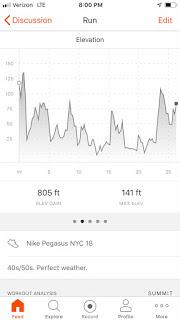
Course profile
2010 NYC Marathon (Bib 7702 / Age 33) = 3:26:01
Pace = 07:52
Place Overall = 4,047 of 44,976, Place Gender = 3,565 of 28,849, Place Age Group = 3,566 of 3,857
Place Age-Graded 6,023 of 28,850
Time Age-Graded 3:26:01
Percentile Age-Graded 60.6%
Splits: 5K 23:11 (23:11 = 7:29) / 10K 46:10 (22:59 = 7:25) / 15K 1:09:44 (22:34 = 7:17) / 20K 1:33:23 (22:39 = 7:18) / 25K 1:57:50 (24:27 = 7:53) / 30K 2:21:54 (24:04 = 7:46) / 35K 2:47:25 (25:31 = 8:14) / 40K 3:14:47 (27:22 = 8:50) / Half 1:38:43 = 7:32 / 26.2 full 3:26:01 = 7:52 (8:09 2nd Hal)

2015 NYC Marathon (Bib 5011 / Age 38) = 3:12:47
Pace = 07:22
Place Overall = 1,709 of 49,461, Place Gender = 1,558 of 28,788, Place Age Group = 302 of 4,562
Place Age-Graded 2,498 of 28,788
Time Age-Graded 3:09:38
Percentile Age-Graded 64.84%
Splits: 5K = 21:19; 10K = 42:42; 15K = 1:04:20; 20K = 1:26:13; Half = 1:31:10; 25K = 1:49:10; 30K = 2:12:20; 35K = 2:36:33; 40K = 3:02:13


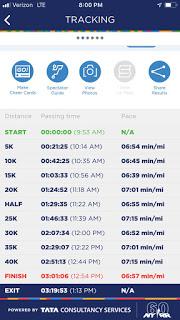
My 5K splits
2018 NYC Marathon (Bib 3211 / Age 41) = 3:01:06
Pace = 6:55
Place Overall 1,275 of 52,700, Place Gender = 1,183 of 30,580, Place Age Group = 228 of 5,109
Place Age-Graded = 1,453 of 30,580
Time Age-Graded = 2:54:55
Percentile Age-Graded = 70.3%
Splits: 5K = 21:25; 10K = 42:25; 15K = 1:03:33; 20K = 1:24:52' Half = 1:29:35; 25K = 1:46:33; 30K = 2:07:34; 35K; 2:29:07; 40K; 2:51:13

Running more overall miles and more miles at tempo pace during training has made me a better marathon runner. Having to run-commute with a backpack and running my son into daycare in a Bob's Blaze jogging stroller has had no negative effect on my training - perhaps it even helped by adding a level of resistance. Adding doubles has helped me in distance racing. And, switching from a set long run on the weekends to more total mileage but no traditional long run has not impacted my training. I hope to be able to use this method to keep improving my marathon and other race times. As documented in previous blogs, since the birth of my son, my training has changed. I have had to move my runs, run/commute with a backpack, run my son to daycare in a stroller, and completely ditch large group runs. While I miss running with my club every Saturday morning and doing track with them every Wednesday night, I’ve found ways to not only continue to train, but to actually increase my mileage and effort. 

This New York City Marathon was the race I hoped Rock N Roll DC earlier this year could have been. Having trained with Shawn for several years now, we planned to race New York together, pacing and pushing ourselves to break 3. It has been tremendously rewarding to witness his transformation into such a strong and smart runner in just a couple of years. By committing himself to doing the mileage and adding in speed, hills, and tempos, he not only dropped his times and qualified both for Boston and New York, he also inspired and challenged me. Plus, selfishly, having a friend and rival to push me and motivate me benefits me. He keeps me from getting complacent. I look forward to training runs where we can talk running, Red Sox and Patriots, politics, or the day's news while testing our VO2 Max or running at recovery pace. Running alone is not as rewarding to me as having a good friend and training partner to keep myself honest.

We're not quite as fast and accomplished as Des and Shalane, but we have pushed each other to achieve results.

Sunday, October 14, 2018

Taper Time for NYC Marathon


One year ago today I ran a negative split at the Hartford Marathon, good for a 3:01. Today marks three weeks to the day of the New York City Marathon. During this blog, I am sharing photos from my last NYC Marathon race in 2015 (2015 recap). In 2015, I ran 3:12 on a warm day, better than the 3:26 from 2010, my first time racing NYC. Now that I think about it, all three of my entries have come in a different way: 2010 was the old "get rejected three times and get in the fourth," 2015 I raised money for a charity in 2012 but that race was canceled due to Hurricane Sandy so I took the guaranteed entry offered for 2015, and 2018 I qualified with my half marathon time.

View of Central Park - the finish line is down there somewhere
It is officially taper time! I've written about the anxiety of the taper before, and with fewer miles to run I have to be judicious about deploying them. I will try to replicate my taper from before the Rock N Roll Marathon where I ran a strong race. Based on how I tapered and adjusting for my tolerance for increased mileage, I'm going to try to stick to the following plan:

Bib and packet pickup at the expo
Week 1 = not to exceed 80 miles, fartlek midweek, and long run with 3,2,1 MP tempo
Week 2 = not to exceed 55 miles, fartlek midweek, and long run with a 20 minute MP tempo
Week 3 = not to exceed 25 miles, 5 x 4 minutes at MP midweek, then Sunday race day!

Pre race waiting to board the bus from Brooklyn to the start at Fort Wadsworth on Staten Island
This week started as a rough one for me. Last weekend on Friday night, I came down with a fever and body aches. I've heard the rule for running when sick is if it is above the head (sniffling, congestion, runny nose) it is okay to run and below the head (body aches) then to skip the run. I ended up canceling Saturday and Sunday's run and on Saturday night decided I would also give myself Monday off (Columbus Day) as well. I thought I was feeling better so I ran on Tuesday, but by Tuesday night my fever had returned and I had a nasty headache. Dayquil got me through the weekend so we could go to activities with my son like attending the pumpkin festival, but I relied on Advil Sinus to make it through my workday (it was pretty effective).

Waiting at the start line
I was able to run again on Friday and on Saturday I ran my son to the National Zoo and back. And earlier today, I ran during Miles' nap - 17.4 miles in 2 hours and 4 minutes with the middle 11 miles at marathon pace (6:45-50). The first four were a struggle but then I found my comfortable pace.

Running mile 17
The Red Sox playoff run is a threat to my taper. In 2013, their last time in the ALCS, their clinching game was the night before the Detroit Marathon. I did okay with a 3:09, but late games are not good for my rest. It is hard to be disciplined when your favorite team makes a deep playoff run.

Snot rocket?
I also have been helping my brother raise money towards his goal of $10K for his charity Dreamfar High School Marathon to get his bib for the Boston Marathon. I solicited 50 of my past donors with the email at the end of this post.

Post race celebration
Dear Friend,

As you may know, this will be my seventh Boston Marathon and while each time I’ve qualified is a truly special accomplishment, this year has added significance. My younger brother Matthew joins me on April 15, 2019, in the Athlete's Village in Hopkinton for his first Boston Marathon!

Not only am I coaching Matthew, we are also working together to raise funds for the charity called Dreamfar High School Marathon (DHSM), an organization that challenges high school students to reach their full potential—physically, socially, emotionally, and academically—through a mentor-supported marathon-training program. Over the years they have served students struggling due to gender identity issues; autism, learning disabilities, and social phobias; severe depression; homelessness, as well as the overwhelming stress to achieve success in the classroom.

We are deeply moved by Dreamfar's mission and want to help them with their goal of reaching every student in New England. If you are able, would you consider making a donation to support our team, please?

You can donate at: https://www.crowdrise.com/o/en/campaign/dhsm2019/matthewames2

Thank you for your support!

Kenny Ames

Running with my brother and our sons in the Bob's Ironman Double Stroller at the National Zoo

Thursday, April 17, 2014

Ready for Boston!

I haven't been able to write as much as I would have liked because I have been finishing up my master's thesis.  I turned it in on April 2 and now I wait for comments from my reviewers; the defense is likely May 5.  It's title Social Media #FTW!: The Influence of Social Media on American Politics.  Message me if you would like to read it.

This week, I'm preparing to run the Boston Marathon.  It's an exciting day as the Commonwealth of Massachusetts takes the day as a holiday and the Red Sox have their 11:05 AM start of a game.  I'm optimistic that it can be my fastest Boston to date based on some solid winter training and two recent personal bests in other distances.  I have raced well lately, in my opinion.  In March, five weeks before Boston, I ran the Rock N Roll USA Half Marathon in DC in 1:25:47 - 15 seconds better than my previous PR.  The course was hilly so I think I had a faster time in me on a flatter course.  In early April, two weeks before Boston, I ran the Cherry Blossom Ten Miler in 63:11, blowing away my previous PR of 64:00 (on a course that was likely short).  I also had a good race at the Club Challenge, which is a notoriously difficult course with lots of challenging and long hills.

I didn't work with my coach this winter since I had too much on my plate (see thesis) so I trained myself.  Since it was a snowy winter, I relied on hill repeats instead of track which was likely icy.  The good part about hill repeats is that if there is a little ice or snow, you can still finish the workout.  I would run a longer warm up, like 6 miles, then do the hill repeats to practice for the hills of Boston that hit between miles 19-21.  I also did a long run of 16 miles around 7:30 miles then the following day raced a 10K so that I would practice racing while tired - again, preparing for the final miles of Boston.    In the two weekends between the half marathon and Cherry Blossom, I ran 22 miles as my long run and 21 miles the following weekend, each averaging a bit faster than 7:30 pace.  Physically, I am ready for this race.

Mentally, I think I am ready as well.  I have a lot on my mind.  Last year's Boston Marathon still echoes in my thoughts.  I truthfully have no idea how I will feel; my family and I were out of the city by the time the bombing occurred.  I know it will be emotional.  The recent passing of my mentor, Arnie Thomas, is weighing on my mind.  Last year, I ran in memory of two of my uncles that passed away in 2012.  I'm sick of running this race in memory of people I care about deeply - please let's not have anymore losses, okay?

I will try to use all this motivation in a goal of doing my best.  My A goal for the day is sub 3 hours; my B goal is sub 3:04 (which would be a PR); my C goal is sub 3:08 (to qualify for next year); and finally, if all else fails, I want to beat my time from last year of 3:19.  I have read and re-read the Sports Guy's article on the Boston Marathon, which I enjoy reading each year.  I'm looking forward to seeing my family.  I have been tapering while observing Passover, and it should be interesting to carbo-load without eating pasta or bread (I'm relying on potatoes, bananas, apples, and yogurt).

The 2014 Boston Marathon is only days away - I can't wait!!

Monday, November 18, 2013

Comparing Red Sox Managers' Leadership Skills

For my leadership class toward my MA in Government, our assignment was to compare two current leaders.  I chose Red Sox skippers Terry Francona and John Farrell.  It really doesn't tie to this blog on running unless you could the running players have to do around bases.

            “Swing and a ground ball stabbed by Foulke.  He has it.  He underhands to first.  And the Boston Red Sox are the World Champions.  For the first time in eighty-six years, the Red Sox have won baseball’s world championship.  Can you believe it (Castiglione 2004)?”
“It hasn’t happened at Fenway Park for ninety-five years!  The Red Sox are World Champions! (Buck 2013)”
The Boston Red Sox have been crowned champions three times (2004, 2007, 2013) in the last decade after a notorious drought that lasted eighty-six years.  This success was made possible due to solid leadership, a shared vision, and the right fits at manager who could communicate the blueprint from ownership to the players.  In 2002, John Henry led an ownership group, including Tom Werner and Larry Lucchino, that purchased the franchise from the Yawkey Trust, and the new ownership changed the culture immediately.  Recognizing the importance of instituting a manager who shared their vision and commitment to winning, Terry Francona was brought in to manage the team in 2004.  Francona won twice but departed after eight years and Bobby Valentine succeeded him.  Valentine was fired after one season in which the team didn’t win seventy games in part due to his deficiencies as a leader and inability to communicate.  To replace him, the ownership recognized the club needed a manager with similar qualities to Francona and brought in John Farrell.
In baseball circles, many often wonder what impact a manager can have on his team.  Some believe that a strong manager can make the difference between winning a title and missing the playoffs.  Others believe that managers would do best to get out of their players’ way to let them just do their thing.  Since these two Red Sox skippers brought these nine (baseball-speak indicting the ball club) to the top of the sport, it is appropriate to compare Terry Francona and John Farrell by examining their leadership styles according to Kouzes and Posner’s Five Practices of Exemplary Leadership: Model the Way, Inspire a Shared Vision, Challenge the Process, Enable Others to Act, and Encourage the Heart (2006, 13).
Model the way: Titles are granted, but exemplary leaders know they must be models of the behavior they expect of others because leaders model the way (Kouzes and Posner 2006, 14).
Being named manager bestows a title, but it is up to the leader to earn respect and influence to wield power gained.  Both Francona and Farrell set the examples for their charges, and players wanted to play for them and would go the extra mile.  Francona had a reputation as a player’s manager who would protect his guys and never embarrass them.  While Francona was being considered for the job, Red Sox General Manager Theo Epstein was pursuing Curt Schilling, a Cy Young winner who formerly played for Francona during his first MLB managerial stint in Philadelphia.  Originally, Schilling wasn’t considering joining Boston until “word leaked out that the Red Sox were interviewing Terry Francona as Grady Little’s possible replacement, Schilling decided he might be willing to go to Boston after all (Mnookin 2007, 243).”  Schilling became a clubhouse leader and courageous follower of Francona’s.  He shared Francona’s goal of bringing a title to Boston, taking on the challenge and inspiring his teammates, most famously by pitching and winning in the playoffs with a surgically secured ankle.
The Sox ownership wanted a manager who would be a partner and not a middle manager.  The right fit would, according to Epstein, “Embrace the exhaustive preparation that the organization demands, and Francona quickly emerged from the applicant pool.  His experiences gave him a remarkable understanding of our vision.  His preparation, energy, integrity, and communication skills are exceptional (Shaughnessy 2005, 39).”  Schilling was also known for thoroughly studying opposing hitters, and because Francona modeled the way, players prepared seriously and that contributed to on-field success.
After the collapse of the 2011 team, which squandered a nine-game lead in September failing to make the postseason, ownership elected to part ways with Terry Francona.  They replaced him with Bobby Valentine, whose style was very different.  Where Francona would go out of his way to protect his players, Valentine would publicly call out players, embarrassing them and calling attention to internal discord.  Valentine verbally sparred with fan-favorite Kevin Youkilis, calling him out for poor play at the beginning of the season causing a rift that he never mended.
Recognizing their mistake that resulted in a contentious 2012 season under volatile skipper, Bobby Valentine, and seeking to restore the kind of leadership displayed by Francona, new Red Sox General Manager Ben Cherington hired John Farrell.  “The Farrell regime represented a return to Francona’s style.  It’s only natural.  John Farrell and Terry Francona were big league teammates with the Indians.  They were great friends.  Their wives and kids were friends.  Francona brought Farrell to the Red Sox as pitching coach for four seasons (Shaughnessy November 2013).”
Farrell understood the importance of laying out clear personal values and setting the tone.  During a spring training interview with the New England Sports Network (NESN), Farrell explained his views on leadership: “I think the thing that stands out about a leader is how he goes about his work.  It’s not so much what he says.  It’s the example that he provides for a starting pitcher.  For instance, what he does in-between starts to prepare for that fifth day.  What is the daily routine for a Shane Victorino, a David Ross, or a Stephen Drew at shortstop – guys that have been added to this roster?  It’s more about keeping that game the focal point and every preparation step along the way that’s needed to put them in a position for success tonight (Farrell 2013).”  Farrell understood that the players would take their cue from him.  He needed to display his dedication to putting the team in a position to win, and the players would follow. 
Inspire a Shared Vision: To enlist people in a vision, leaders must know their constituents and speak their language (Kouzes and Posner 2006, 15).
Terry Francona had to display that he could communicate in an appropriate manner with his players early on in his tenure.  At the beginning of his first spring training in Boston, there was the annual big meeting to kick off the season where ownership, the general manager, manager, traveling secretary, public relations director, equipment manager, and a representative from the Red Sox Foundation addressed the entire ball club.  This provides the organization with a shared vision for the year while plotting out strategy and mission.  The meeting was to begin at 9:00 AM, but as time approached, Francona noticed Manny Ramirez wasn’t there.  Ramirez was known for being absent-minded and acting out at times, giving birth to the phrase, “Manny being Manny.”  If Ramirez missed this meeting, it had the potential to create a press firestorm and torpedo the new manager.  Francona recruited the affable and popular designated hitter, David Ortiz, who is affectionately called Big Papi by teammates and fans and is a friend of Ramirez’s, to go get him.  Ortiz recognized the situation and respected the way Francona wished to handle this, opting to let a player bring another player to the meeting to avoid making a scene.  The next day, Ramirez approached the manager during spring training drills, draped his arm around him, and said, “I’ll hit third, I’ll hit fourth, I don’t care.  I’ll do whatever you want. (Francona and Shaughnessy 2013, 77).”  This reaction showed that Ramirez valued the way the new manager’s style.
Francona avoided a pitfall by appealing to Ortiz’s shared aspirations.  He let a friend bring Ramirez rather than potentially embarrass the temperamental All-Star.  Farrell also believes in this approach and has had the chance to display it.  A few players lost focus during Francona’s final season with Boston, creating a press storm when they were rumored to be eating chicken and drinking beer in the clubhouse during games.  Their performances suffered, but they were still talented pitchers.  Farrell was able to inspire them to return to a solid workout regimen that produced wins and a low staff ERA.  He earned their trust and respect by appealing to shared aspirations of greatness.
Red Sox Chairman Tom Werner: “John has demonstrated extraordinary leadership ever since he became our manager last winter.  John has the team focused on winning, the clubhouse is happy, and the players grind out at-bats.  His skills range from his calm nature to his in-game strategy.  Whether communicating with our core group of stars or the role players coming up and down from Pawtucket, he has everyone’s trust (Shaughnessy July 2013).”
Challenge the Process: Leaders venture out and are learners.  They learn from mistakes and seek ways to change, grow, and improve (Kouzes and Posner 2006, 17).
The Red Sox ownership rely on a type of data-driven statistics known as Sabermetrics, a methodology popularized by Bill James and expanded upon by the publication Baseball Prospectus.  Not all managers subscribe to this forward-thinking approach; some rely on old-fashioned trusting one’s instincts, eschewing data.  The Red Sox needed to make sure their managers shared and conveyed their approach to the players.  “Francona seemed to intuit the need to combine a deft interpersonal approach with the utilization of as much information as he could possibly get his hands on.  It was clear that Francona would never eschew the detailed reports the team put together (Mnookin 2007, 247).”  Francona and Farrell bought into this innovative approach and succeeded by playing the percentages, which is the heart of what Sabermetrics is.
Both Francona and Farrell had previous managerial jobs in the majors, and both struggled initially.  Francona had four mediocre seasons managing the Phillies in the late 1990s.  But, he learned from his mistakes and was able to use that to his advantage in Boston.  “Francona’s pliability, a flaw in Philadelphia, would be an asset in Boston, where it was reframed as a willingness to learn and grow (Goldman 2005, 29).”
In his first season Philadelphia in 1997, Francona sought to change the direction of his club which he did midseason in a closed door meeting: “He blasted his team – and they promptly won thirty-eight of their last fifty games.  Francona was applauded for his handling of the situation and his ability to motivate a team that had little viable pitching after Schilling and a mismatched roster (Goldman 2005, 27).”
Farrell also failed in his first managerial stint in Toronto.  The Blue Jays were dismayed with his performance after two years and willing to let him go to the Red Sox.  But, he learned from those seasons and applied the lessons to his leadership approach in Boston.  Red Sox second basemen Dustin Pedroia, a former Rookie of the Year and American League Most Valuable Player: “The thing with John is he’s so smart.  I think it seems like he learns from every single person he’s around in baseball.  John has been unbelievable with all of us, just the communication (Ulman 2013).”
Also, Farrell showed strong leadership during the World Series by admitting he made a crucial mistake during Game 3 that possibly cost the Red Sox the game.  In the top of the ninth with the game tied at four runs apiece, Farrell failed to initiate a double-switch at first base and pitcher electing to allow the pitcher to hit.  The Cardinals won 5-4 in the bottom of the ninth on an obstruction play.  After the game, he conceded, “In retrospect, sure, I would have liked to use a pinch hitter (Ulman 2013).”  Down two games to one after the loss, the Red Sox won three straight to win the World Series.
Enable others to act: Excellent leaders foster collaboration because they know that trusting others pays off.  They understand that those under them are expected to produce results and that they must feel a sense of personal power and ownership (Kouzes and Posner 2006, 18).
Francona established a trust system by empowering his players and promoting cooperative goals.  He treated the players as men, yet made clear what he expected of them: “I put the rules out there each year to protect myself.  I wasn’t going to check curfew.  No manager does.  But if somebody did something stupid at night, I could say, ‘This is the rule.’  It was all just basic commonsense stuff: be on time, be respectful, play your ass off (Francona and Shaughnessy 2013, 76).”
An example of how Francona built trust was how he handled his first game as skipper.  In the 2004 Red Sox season opener, ace pitcher and part-time prima donna, Pedro Martinez, did not have his best stuff and took the loss in Baltimore.  In a huff, he left the ballpark before the game was over, infuriating Francona.  However, it is not his style to call out players publicly, especially on his first night on the job.  Yet, he managed the situation deftly by telling the press, “In all fairness to [Martinez], and everybody else, that [rule about leaving early] wasn’t conveyed correctly on my part, and I take responsibility for that (Francona and Shaughnessy 2013, 83).”
“Francona made it a point never to criticize any of his players in public.  If harsh words were uttered behind closed doors, no one heard about it (Shaughnessy 2005, 81).”  That was Francona’s modus operandi: when Sox players misbehaved, he addressed it inside the clubhouse and then diminished the indiscretion to the media.  This style has earned him the perception as a player’s manager because they trusted he would make them look good; the team appreciated his fostering of collaboration by taking the blame.
Farrell operates in a similar manner and that has helped him build a strong relationship with his coaches.  Like Francona, he does not seek attention by criticizing his players or coaches outside of the clubhouse.  An example of how he shared power is on display with his pitching coach, Juan Nieves.  While Farrell served as pitching coach for Francona, he hired Nieves for the role and stays out of his way to let him do his job.  Some leaders can have a tough time relinquishing a role they served prior to their promotion, creating a difficult situation when supervising the new incumbent.  Yet, Farrell respects Nieves and lets him handle the pitchers: his faith of placing his trust in Nieves has been rewarded through a 3.79 staff earned run average, nearly a run less than the 2012 Sox and Boston’s best in eleven years (Ulman 2013).
Encourage the heart: The climb to the top is often arduous and long so people can become exhausted, frustrated, and disenchanted.  Leaders recognize the temptation to give up yet encourage the heart of their team and celebrate success through a spirit of community (Kouzes and Posner 2006, 19).
In the 2004 American League Championship Series, the Boston Red Sox found themselves down three games to none to their hated rivals, the New York Yankees.  No team in baseball history had ever won a best-of-seven series when trailing by such a deficit; in fact, no team had ever rallied to force a Game 7.  Francona kept the team in a positive frame of mind and only thinking about having to win one game at a time rather than focusing on the daunting task of taking four straight.  He avoided the appearance of panic by ensuring his players saw that he wasn’t doing anything differently.  Although his stomach was churning, he knew that when things are getting out of control, players take their cue from the manager.  It was important that he appeared calm and focused: he wasn’t going to give them an excuse to quit.  He told the press after dropping Game 3, “We’re going to show up tomorrow and try to play one pitch at a time, one inning at a time (Francona and Shaughnessy 2013, 112).” 
And the players responded with optimism.  First baseman Kevin Millar told everyone, “Don’t let us win tonight.  If we win, we’ve got Pedro going tomorrow, then Schilling, and then anything can happen in Game 7 (Francona and Shaughnessy 2013, 113).”  Schilling handed out shirts that read, “Why Not Us?” referring to their chance to make history.  And the Red Sox did make history by winning the next two at Fenway in extra innings, winning Game 6 in New York with Schilling pitching on his bad ankle, and blowing away the Yankees in the clincher in Yankees Stadium en route to the title.
John Farrell was brought in to change the direction from the disastrous Valentine era.  “Farrell has brought leadership and dignity back to the corner office at Fenway and the Red Sox at the All-Star break have more wins than any team in baseball.  He has brought back the Tito style of putting the feelings of the players ahead of everything else.  And it is working magically (Shaughnessy July 2013).”
Farrell was able to encourage the team in the way the veterans still on the team were treated by Francona.  Red Sox pitcher Clay Bucholz recalled, “It’s almost exactly the way it was back then [under Francona].  This is the way our clubhouse used to be.  Players get treated with respect, like a professional.  That’s the way it should be (Shaughnessy July 2013).”  Farrell showed his appreciation for individual excellence and that recreated a spirit of community that Francona had built.  He acknowledged the role Francona played, “He taught me a lot.  He has a keen intuitive feel for the game (Shaughnessy November 2013).”  Once restoring that blueprint, Farrell was able to guide the team from worst to first.
Conclusion: Terry Francona and John Farrell are very similar in their leadership styles and personalities, and both accomplished the ultimate goal of a Major League Baseball manager: to guide their ball club to a World Series triumph – and they did it in their first seasons in Boston.  Professional baseball is a multimillion-dollar enterprise; so employing the right manager to direct a clubhouse of twenty-five talented and competitive men is crucial.  This season, Francona returned to the dugout as manager of the Cleveland Indians, his first year back as skipper after his Red Sox days ended.  He guided a club back to the playoffs for the first time since 2007, and the Baseball Writers of America selected him as American League Manager of the Year.  He beat out John Farrell, who came in second; but the Red Sox and Farrell can console themselves with their eighth title in franchise history and the comfort of knowing solid leadership has been restored.
Sources

Buck, Joe.  Announcer for the World Series.  Fox Sports.  October 30, 2013.

Castiglione, Joe.  Announcer for the World Series.  WEEI.  October 27, 2004.

Farrell, John.  “Spring Training Interview on Leadership.”  NESN.  March 30, 2013.

Francona, Terry, and Dan Shaughnessy. Francona: The Red Sox Years. Houghton Mifflin Harcourt.  2013.

Goldman, Steven, ed. Mind Game: How the Boston Red Sox Got Smart Won a World Series, and Created a New BLueprint for Winning. Workman Publishing, 2005.

Kouzes, James M., and Barry Z. Posner. The leadership challenge. Vol. 3. Wiley. 2006.

Mnookin, Seth. Feeding the monster: How money, smarts, and nerve took a team to the top. Simon and Schuster. 2007.

Shaughnessy, Dan.  “Indians’ Terry Francona over Red Sox’ John Farrell for American League Manager of Year a shocker.”  The Boston Globe.  November 13, 2013.

Shaughnessy, Dan.  “John Farrell proves right man for the job in guiding Red Sox.”  The Boston Globe.  July 15, 2013.

Shaughnessy, Dan. Reversing the Curse: Inside the 2004 Boston Red Sox. Houghton Mifflin Harcourt. 2005.


Ulman, Howard.  “Manager John Farrell’s steady leadership brings Red Sox from last place to World Series.”  The Associated Press.  October 30, 2013.